
CHAPTER 2
Retreat
A few months before my indictment, I was traveling in Mongolia with my Lama,
who had spent decades in Northern India and Nepal studying with Tibetan monks until he had become an accomplished lama himself. I said out loud something I had always wanted. “I want to do a three-year retreat.” Three years of structured practice and quiet, no life-multitasking, no performance. He gave me a warm, amused look, as if saying, be careful what you say, they hear you.I understood what he meant; thirty years prior, I’d had a similar interaction after watching my first demonstration of the practice that eventually became Orgasmic Meditation.
I get it now. The road to the real thing looks nothing like the polished moment. It’s
harrowing, grueling, mostly dark with pinholes of light. You’re tied to a bucking bull
until, for reasons beyond you, it stops. That’s why I laugh when people accuse me of
luring people into spirituality. Please. The part of you that wants the real thing
cannot be seduced.
It has its own key and its own lock. I’ve spent years at the gate shooing away the tourists. The real ones keep coming anyway.
After I was indicted, I contemplated what it would be like to go to prison. I worried about comfort: Would I be able to eat the food in prison? Have bathroom privacy? Exercise?
A few days in and I was surprised how little those things mattered. Only one restroom locks. The water runs hot, not cold. The food is…fine. And my digestion, sleep, and overall well-being are the best they’ve been in years. Also, Mari slipped us enough tea to make it to commissary day, which felt like winning the lottery.Also, Mari slipped us enough tea to make it to commissary day, which felt like winning the lottery.

The restrictions here serve the same purpose as in a meditation hall: The very limits
make you free. Certain times of day require specific behaviors.
Twice a day during the week, three times a day on weekends, you must be in a bunk area of the dorm,behind a blue line of tiles on the floor for “recall.” Movement becomes even more restricted.
“Count” happens after recall and you must stand by your bed. I know the schedule for “mainline” meals.
All my other time I spend meditating.
Sometimes there’s a disruption—a visit, medical forms—then I adapt and go back in.I sit meditation about four hours a day, do various breathing techniques,
including tummo which heats the body from the inside, a little yoga (not enough), walk the track, and write. I want to get to seven hours of practice. I think I can.What I am finally understanding is this: If you want the deep quiet, you have to let go; you can’t hedge your bets. You can’t say, “Yes, I want freedom—but I also want a picture-perfect partner, rock-solid finances, and the same public life.” That’s how freedom ends up last in the race, still in the gate with its saddle on.
A woman wants a man who can hold her up - a partner she doesn’t have to prop.
I think that wish points to something deeper: the soul’s desire for a happiness thatholds us up, instead of the endless managing—the shell game of if-I-just. If I justmake this meal. If I just get this outcome. If I just get through this. Before beingremanded, it was the next interview, the next legal report, the next call.I feel my purpose shifting. Maybe it’s energetic, not logistical. Maybe my work isn’t interviews, teaching, and designing programs anymore.
All that is gone. I used to wake and scan the horizon for bad news—or, just as unsettling, hopeful news of something that might somehow extricate me from my situation.

But either way the news came, it was still oriented around fear. Fear that I would end up exactly where I am today.
It’s funny how long I taught that inside what you most fear is what you most want.
And here I am: I ate my demons. They’re in my belly now, not the other way around.My teachers would talk about the dakinis—sky-dancer women, embodiments of wisdom—who devour fear, shame, ego-clutching. She doesn’t banish it; she chews it up and turns it into fuel for flight.
In truth, they’re not ethereal dancers in red silk, floating across temple murals. If you really want to find them, you go to the charnel grounds - the cremation field of burning and decay where everything you cling to as “me” and “mine” is stripped away.
The dakini doesn’t show up to flatter you or fix your life. She appears where life has already blown your cover and sits with you in the ashes until you stop pretending you’re in control.What makes her dakini is that she’s always in flight—not escaping, but refusing to
land on anything solid and pretend it holds any truth. The ego wants to createcomfort by creating some solidity, some identity to cling to: I’m the good one, I’mthe ruined one, I’m the one who’s got it handled. The dakini is allergic to that kind ofcertainty. She’ll tear it out of your hands, cut it out of you if she has to. One minuteshe feels like fierce love, the next like total abandonment, but underneath both is thesame invitation: Let go of the fixed identity, stay in the open sky.Had it occurred to me that a modern charnel ground might be a pink cinderblock prison dorm?
But that’s what this is: a place where bodies age, illusions die, and every role you’ve ever played—teacher, lover, mother, villain, victim—gets ground down to powder. To be a dakini here isn’t about being mystical or special. It’s being willing to live in this fluorescent charnel ground without numbing out, to keep your heart bare and your feet off the fake safety of a fixed story, even when every instinct begs you to land.
I’m being rearranged at a breakneck pace. Humbling doesn’t cover it.
I don’t want a phone anymore. I don’t want constant communication. I want a uniform and a bare face. Some women smuggle in the old life to rehearse for having it again. I don’t.
For me, this is the next level of sobriety—being sober from the world.
I read a line last night that stuck with me: A true seeker is an insider, someone who realizes happiness is an inside job. The opposite is the outsider, always hunting for meaning “out there.”
Prison, at the soul level, sobers you up from the outside hunt. Maybe I was too entangled with the world to hear what the heart wanted, so life called me home. If “home” came with a bit more silence, I wouldn’t mind—but I’m working with what
I’ve got. I redesign my days, not as an activist tallying shortages (whether the ice machine is broken one day or the commissary is thin on stock), but as a curator:
What are the few jewels we do have, and how do I place them so they shine?
What I have, and can barely put into words, feels like a blessing. On Saturdays I get to talk to my Lama for about fifteen minutes. As strong as I know I am, those fifteen minutes work like a time-release capsule; they keep dissolving through the week, lifting me when I might otherwise just trudge through the mud of this experience.
It’s not even about what we say—how much can you really cover in fifteen minutes?—it’s that we meet and laugh and, without my noticing, I am suddenly filled with light. I’m so brimming with it that I want to tell him how much I love him, but instead I try to show it. After our calls, I walk through the dorm and share the surplus, looking for the corners that most need it. I do my best in his name.That is what I know love to be: a love that invites you into your own greatness. I pray that every woman has this kind of love at least once in her life, in a world that keeps telling us love means selling your soul.

If I am lucky, that is what I am most lucky for. I know love can be a hard-fought commodity, and without that basic need met, it can be near impossible to see what’s available here in prison.I also know these are women who haven’t done retreat.What’s “unbearable” in here is a normal day in a meditation hall. No one’sthwacking you with a stick when you nod off. Most officers are civil; a few aredownright kind. My favorite looks like a stern drill-sergeant version of a churchminister and runs a tight ship. My nervous system settles when he has us in our aislesinstead of the all-night block party free-for-all that reigns at other times.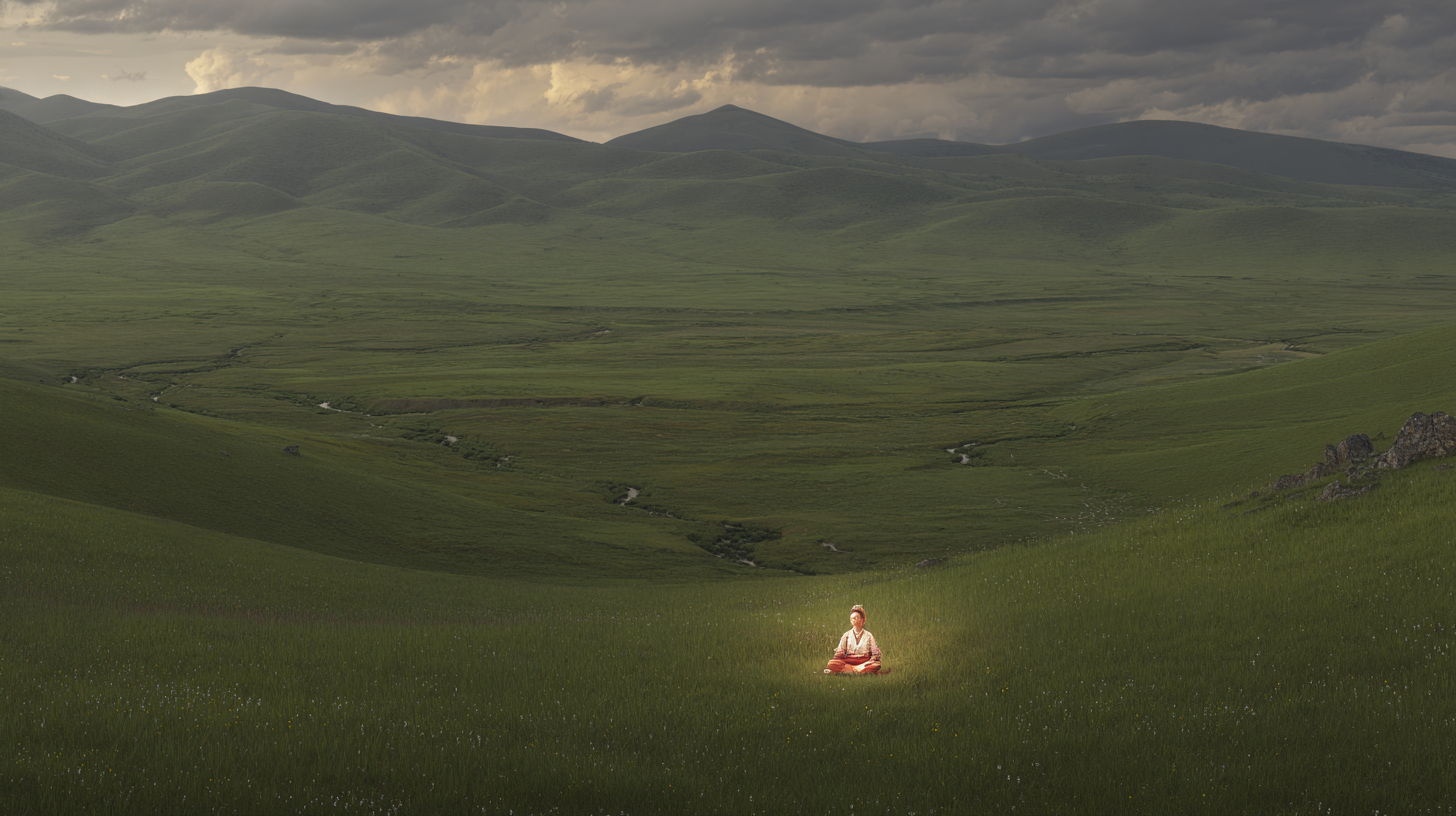
In here, I don’t have to lead anything. I’m at effect—not the decider, not the knower.
Decision fatigue is real. Those first few days before my email account and phone were set up were a particular kind of life-quiet: no updates from friends, no updates on projects. A kind of hermit’s life: simple, steady, quiet.
It can be uncomfortable if you’re not used to it, but it can also feel like a great relief.
Most of the enemies you’re fighting live in your own head. But when you rest in the
clear, steady part of you—the one that exists underneath the weather stirred up by
the everyday happenings of life—the attacks have nothing to land on. That’s been
my method for years. People may ask you to be a warrior-queen swinging a sword
but honestly, most fighting is just shadow boxing. Still, I had to fight long enough to
see fighting wasn’t helping. And I refuse to grant manufactured conflict the dignity
of a duel.
I thought I came here to be broken.
Maybe I came here to be simple, stripped of any last tethers to the ground beneath me